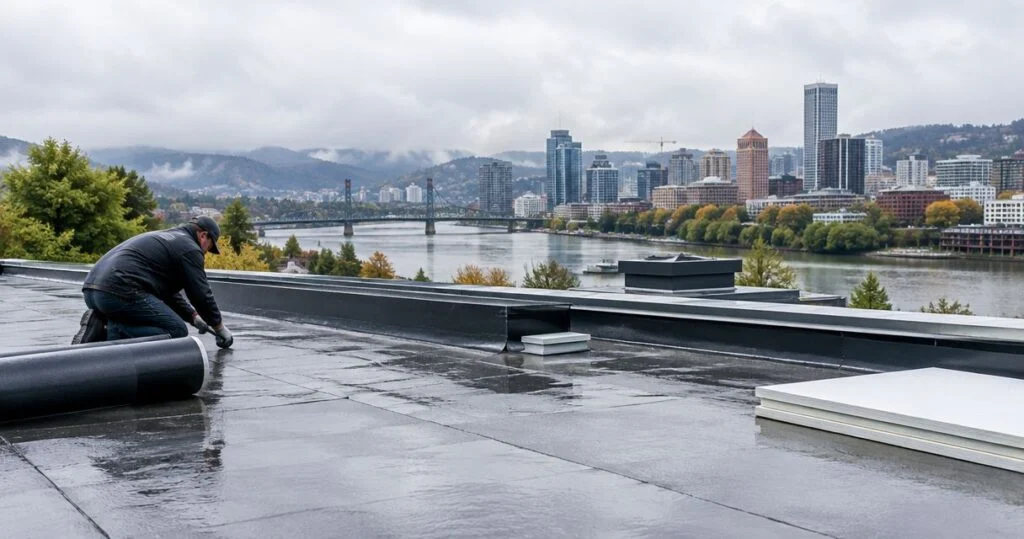
For Portland homeowners comparing the best flat roofing materials, start with the roof's drainage and the details around walls, drains and chimneys. The strongest roof plan brings the membrane, its seams and those connections together. Lioncrest installs peel-and-stick roofing for low-slope roofs and evaluates the existing roof before explaining the replacement work.
At a glance: low-slope roofing choices
Peel-and-stick describes how roofing is attached. Modified bitumen, TPO, PVC and EPDM describe different material families. Knowing that distinction makes a roofing proposal easier to understand.
| Roofing option | Defining feature | What to discuss |
|---|---|---|
| Peel-and-stick roofing | Self-adhering roofing sheets | Surface preparation, overlaps and flashing |
| Modified bitumen | Reinforced, polymer-modified asphalt sheets | The complete assembly and application method |
| TPO or PVC | Thermoplastic membranes with heat-welded seams | Seams, perimeter attachment and penetrations |
| EPDM | Synthetic-rubber membrane | Specified seam tapes, adhesives and flashing details |
1. Peel-and-stick roofing: Lioncrest's low-slope offering
Peel-and-stick roofing uses a self-adhering underside to attach the roofing sheet to the prepared surface. Installation brings together surface preparation, aligned courses, sealed overlaps and carefully finished edges. Those details give the roof a continuous route for shedding water.
For a Portland porch, addition or other low-slope area, start by identifying how that roof meets the rest of the house. A wall connection, a transition from a steeper roof and a nearby gutter each need their own detail. Lioncrest reviews the existing roof and explains the work needed for replacement.
Ask to see the proposed roofing product and a clear description of the installation. The useful discussion covers the roof surface, the layers beneath it, the edges and the route rainwater takes away from the building.
2. Modified bitumen: understand the material and application
Modified bitumen combines asphalt with polymer modification and reinforcement. It is supplied in sheets used in low-slope roofing assemblies. Self-adhered systems are one application approach; other systems use adhesives or heat. That is why a proposal should identify both the material and the method of installation.
Peel-and-stick and modified bitumen are not competing labels for the same kind of choice. One describes attachment and the other describes a material family. Reading the product name and assembly description together gives a clearer picture than a broad roofing label.
3. TPO and PVC: heat-welded membrane systems
TPO and PVC are thermoplastic roofing membranes. Installers join adjoining sheets with heat-welding equipment and use system-specific details at edges, walls, drains and penetrations. The finished roof brings those welded connections together with the membrane surface.
These names often appear in research about commercial and low-slope roofing. When comparing roof materials, look at the full assembly: deck, insulation, attachment, membrane, flashing and drainage. A material name describes only one part of that plan.
4. EPDM: a synthetic-rubber membrane
EPDM is a synthetic-rubber roofing membrane. Its seams and flashing use the system's specified tapes, adhesives and accessories. This is a different joining approach from the thermoplastic heat-welding used for TPO and PVC.
The practical questions remain familiar: how the roof is prepared, how adjoining sheets connect, how penetrations are finished and where water exits. Those details help homeowners understand what a complete replacement involves.
Drainage comes first in Portland's wet weather
A low-slope roof needs a deliberate path for rainwater. Start at the high points and follow that path toward the roof's gutters, drains or scuppers. Then consider the walls, roof edges and openings water passes along the way.
- Slope: Identify the direction water travels across the roof.
- Outlets: Locate the gutters, drains or scuppers that carry it away.
- Overflow: Understand where water goes when the normal outlet becomes blocked.
- Flashing: Review the connections at walls, chimneys, vents and roof edges.
- Maintenance: Keep drainage routes clear of leaves and debris.
Describe leaks, visible standing water or overflow from a safe location. Let a roofing professional inspect the roof surface and its connections. Wet low-slope roofs are not a safe place for a homeowner to investigate on foot.
What to look for in a replacement plan
A clear plan starts with the existing roof and explains the proposed work in plain language. Look for the roofing product, surface preparation, flashing work, drainage details and treatment of adjoining roof sections. Photos help connect those details to the actual building.
A porch roof beneath an upper-story window presents a different set of connections from a low-slope addition beside a chimney. Give those junctions attention during the inspection so they are part of the plan from the start.
Frequently asked questions
What low-slope roofing does Lioncrest install?
Lioncrest installs peel-and-stick roofing for low-slope roofs. The team evaluates the existing roof and explains the work needed for replacement.
Does a flat roof need slope?
A low-slope roof needs a deliberate path for water to drain. The roof plan brings together slope, gutters or drains, overflow routes and flashing.
What is the difference between TPO, PVC and EPDM?
TPO and PVC are thermoplastic roofing membranes with heat-welded seams. EPDM is a synthetic-rubber membrane using specified seam tapes, adhesives and flashing accessories.
Lioncrest Roofing & Chimney has more than 30 years in business and provides roofing and chimney services in the Portland area. For low-slope roofs, Lioncrest installs peel-and-stick roofing. Start with a review of the roof, its drainage and the places it connects to the home.
Explore Lioncrest's flat roofing service or request a roof inspection.
How this comparison was organized
This guide explains material families and installation approaches, then connects them to the drainage and flashing questions homeowners face. Peel-and-stick comes first because it is Lioncrest's stated low-slope roofing offering. The other sections explain terms commonly encountered when researching flat roofs.
Related guides
- Best roofing materials for Portland's rainy climate
- Best asphalt shingle brands for the Pacific Northwest