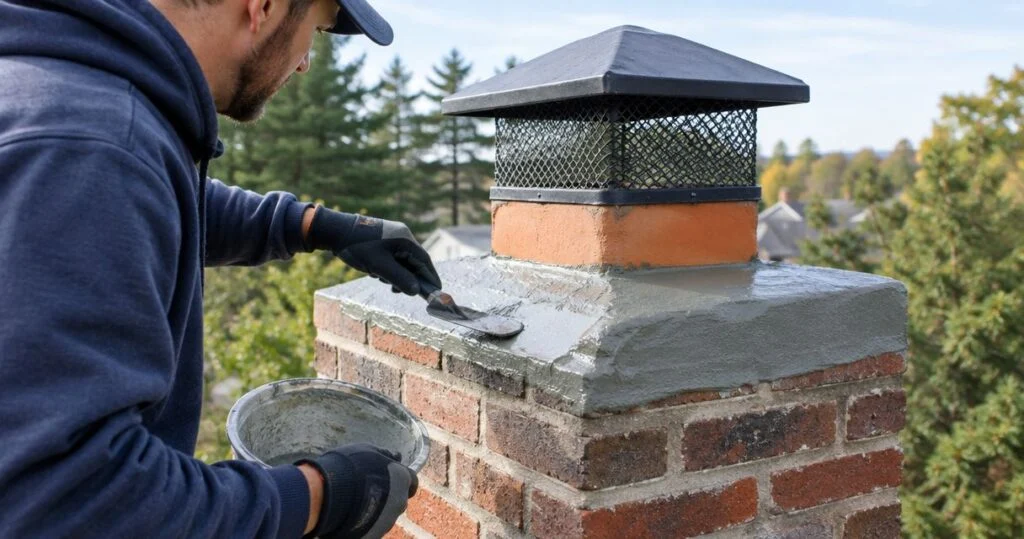
For a sound chimney crown with minor surface cracks, our starting point is a crown-specific coating with localized repairs where needed. For a crown that is loose or crumbling throughout, replacement is the better path. Patching cement, crown coatings, joint sealants and replacement concrete do different jobs. Choosing between them starts with the condition of the crown.
Best chimney crown repair materials at a glance
- Crown coating: surface protection for a solid crown.
- Cementitious patching material: localized missing or damaged material on a sound base.
- Joint or crack sealant: targeted treatment of an opening, not a replacement for the crown itself.
- Replacement concrete: reconstruction when the crown has failed.
1. Crown coating: best for surface protection
A crown-specific coating forms a protective membrane over the crown. This is a useful option when the underlying crown remains solid and the damage is limited.
For example, SaverSystems' CrownCoat label describes a flexible waterproof membrane and requires a structurally sound surface. It also describes filling larger individual cracks or voids before coating. That is why a coating proposal can include localized repair work.
Our take: protect a sound crown rather than replace it unnecessarily, but do not use a thin surface coating to hide widespread deterioration.
2. Cementitious patching material: best for localized damage
Patching addresses a specific damaged area while retaining the sound crown around it. A broken spot and a crown that is crumbling throughout are different repair problems.
A purpose-selected cementitious repair material fills or restores the damaged area. It is not the same decision as spreading ordinary bricklaying mortar over the entire top. CrownSaver, for example, is a formulated cement-based crown repair system rather than a generic mortar mix.
Our take: localized repair makes sense when there is a sound base to retain. Repeated patches are not a substitute for replacing a failed crown.
3. Joint and crack sealants: best for targeted openings
Sealant can serve a specific joint or crack within a crown repair. It should not be confused with the crown coating that covers the broader surface: both can be flexible, but their roles are different.
The CrownCoat instructions distinguish crack filling with patching cement or caulking from the coating applied over the crown. Filling one opening does not restore a deteriorated crown body.
Our take: identify what the sealant is treating. A tube of caulk is not a whole-crown replacement.
4. Concrete replacement: best for a failed crown
When the crown is no longer a sound base for repair, reconstruction replaces the failed material instead of covering it. A properly formed replacement also addresses the crown's shape and water-shedding edges.
The Chimney Safety Institute of America identifies a cast crown with an expansion joint as a durable replacement for common sand-and-mortar washes.
Our take: choose reconstruction for a failed crown, not another cosmetic surface treatment. Replacing the crown is different from a full chimney rebuild; sound brickwork below it can be a separate part of the assessment.
Compare the repair scope, not just the product name
A useful proposal explains which areas will be patched, which joints need attention, whether a coating is included and whether the crown will be replaced. That makes two estimates easier to compare than a line that simply says “seal chimney.”
Lioncrest Roofing & Chimney evaluates crown damage alongside masonry, caps and flashing for Portland-area homeowners. Book a free chimney repair estimate to discuss the work your chimney needs.
Frequently asked questions
Is a chimney crown the same as a chimney cap?
No. The crown is the top surface around the flue openings. The cap sits above a flue opening. Identifying the damaged component helps define the repair.
Is coating better than patching?
They serve different purposes and can be used together. Patching addresses localized damage; a crown coating protects the surface.
Does missing concrete always mean replacement?
No. A localized defect on a solid crown can be repairable. The key distinction is whether sound material remains to support the repair or the crown has broadly deteriorated.
Can Lioncrest assess more than the crown?
Yes. Lioncrest provides chimney repairs and chimney inspections, including evaluation of other chimney components.